My apologies for the blogging hiatus. My transition to Dakar has left me without the colorful stories of village life to inspire posts. It hasn't all been days spent on the computer at my office, though! I present my final photo essay in Senegal, detailing the more exciting moments of the last five months.
Sunday, April 17, 2016
Wednesday, October 28, 2015
Final Lessons from a Small Village
Two years
ago I watched the Peace Corps car drive away and leave me in my minute village
in the middle of Senegal. Over the
ensuing 24 months I learned a variety of lessons, from how to butcher my own
chicken and substitute a hole in the ground for a toilet, to how to organize
youth camps for over 60 participants.
These are some of the lessons I am particularly proud of…
How to…
CARRY WATER.
Life in my
community revolves around the well. Since
there are no faucets or spigots, all water for cooking, washing, cleaning, and
agriculture comes from this single source.
Pulling groundwater up 75 feet by hand and then carrying 50 lbs of it at
a time on your head creates an acute awareness of how much water you use.
I learned how to flag down buses, hop on horse-drawn carts, bargain for the best seats in 1960’s era station wagons, and perch in precarious bush taxis. Perhaps more importantly, traveling in Senegal taught me patience. I live along an infrequently traveled dirt road; waiting anywhere from 2 to 12 hours for a passing car is the norm. Traveling from my regional capital back to my village is an all-day affair, taking 12 hours to travel just over 50 miles. While the cars go significantly slower than in the States, it’s waiting at transport hubs that eats up time. You have to wait until are all the seats are filled in a car before leaving. I’m usually one of the first to show up for my 20-seater bush taxi, but instead of despairing I tend to get absorbed in a long book and delicious street food.
How to…
ENJOY BREAKFAST SANDWICHES.
The
ubiquitous breakfast food, if you’re dining out, is a breakfast sandwich. Made by ladies in curtained stalls at large
markets, big cities, or in public transportation garages there are my favorite
Senegalese street food. Dealing with
impatient, pushy customers every morning; these indomitable ladies are the true
entrepreneurs of Senegal.
In my area
the bread is a heavy mix of flour and ground millet filled with beans or an
oily onion sauce. A trip to larger
cities enlarges the menu to include peas, hard boiled eggs, fried eggs, fries,
fish sauce, vegetables, French baguettes, or stale ‘machine’ bread all to be
garnered with pepper, hot pepper, or fresh mayonnaise. My village doesn’t have a breakfast sandwich
lady so I have spent many days, especially during ‘starving season,’ fantasizing
about which sandwich combination I’ll order the next time I travel.
How to… SCARE CHILDREN.
There’s
nothing quite like the feeling you get when you enter a room and over half the
children under 10 start sobbing and reaching for their mothers. Especially frustrating moments ensue when
babies you’ve known their whole life develop good enough eyesight to actually see you and then have this reaction. Seriously?
I was at your naming ceremony!
I would like
it on the record that there are currently no children afraid of my in my
community, but there’s a month-old baby my replacement will have to contend
with.
How to…
DANCE.
Turn over
your metal lunch bowl and start drumming a beat and my feet will start pounding
and my arms flailing. My teenage sisters
have taught me each Senegalese song’s corresponding dance moves. I can cup my hands and twist my shoulders,
throw my elbows in the air, sashay, or hold up my skirt’s hem to pound my
feet. Women and men do not mix, which is
a small blessing because having to dance in a circle of sixty on looking ladies
is enough intimidation for me! Still, it’s
quite the rush of adrenaline to hear a song, yell ‘I know this one!’ and jump
into the circle for a moment in the limelight.
How to… MAKE
TIME TO READ.
With no
electronics or television, reading was my only distraction at site. During stifling afternoons in hot season and
long days of travel, I devoured dozens of books. A full list (and recommendations) is on their
way.
How to… SIT.
No
television and high illiteracy rates means that my community members spend
their down time sitting. On individual
wooden benches and plastic mats we napped, cracked peanuts, made hundreds of
rounds of tea, and talked.
Or did
nothing at all.
When I first
attempted to spend an hour sitting at a neighbor’s compound, the equivalent of
a social call, time dragged interminably.
But now I can spend an entire afternoon perched on my mat, mindlessly
cracking peanuts or sorting beans in total bliss.
How to… BIKE
IN THE BUSH.
Public
transportation doesn’t connect my village with my neighboring Peace Corps
Volunteers. So we slather on sunscreen
and bike to one another’s communities on a fairly regular basis. Some of my favorite moments have been on a
bike on the peaceful dirt paths. I’ve
become such a proficient that I often augment my time on my bike with lengthy
phone calls or by enjoying street food.
How to…
GARDEN.
When I came
to Senegal I was not a trained agronomist.
I had never grown my own garden.
Ironically, it was in a country facing desertification and food
insecurity I learned to grow my own eclectic mix of vegetables, cereals,
flowers, and trees. My piece de resistances
are the much needed shade trees in my backyard that have grown over 20 ft tall
in less than 18 months.
How to… USE
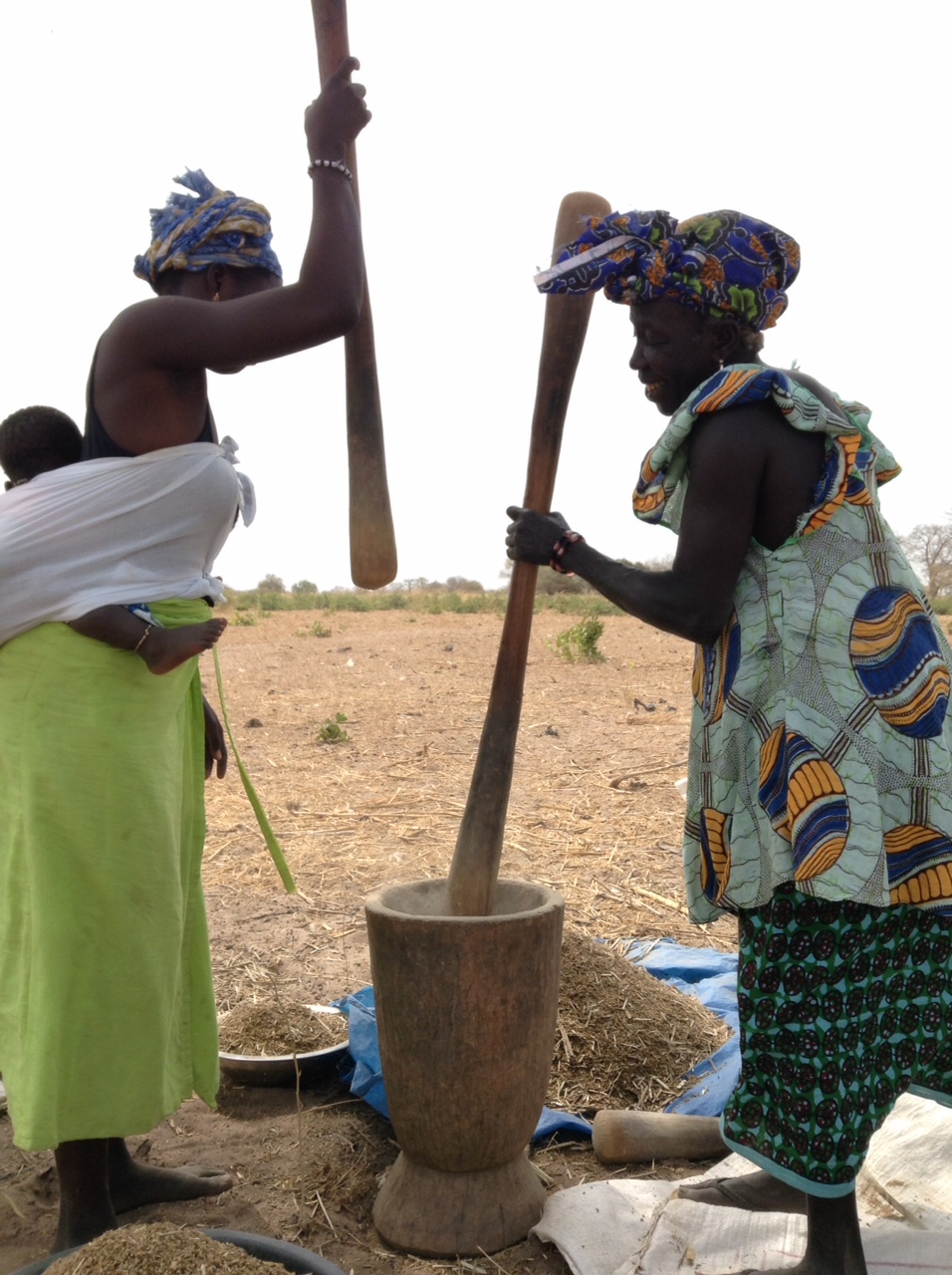
A MORTAR AND PESTLE.
In a kitchen
without food processors, whisks, electric mixers, coffee grinders, or bags of
processed flour, the mortar and pestle reign supreme. I wake every morning to the muffled thuds of
each household pounding their coffee beans for breakfast. Daily, millet grains are pounded into flour
for the evening’s millet ‘cous-cous.’
Harvesting millet, sorghum, or corn?
Throw the dried candle, head, or ear in and pound the edible portion
off.
Pounding can
be done by one, two, or three women surrounding the mortar. To keep the rhythm0 of multiple pestles
quickly pounding, the women clap their hands on the upswing. With pestles weighing about 15 lbs, the force
needed with each throw, and the pound-per-second rate it can be an exhausting experience. All the pre-teen girls have more developed
muscles from pounding grains every day than most light-weight boxers. It took me two months for me to build the muscles
and callouses needed to pound for over five minutes and throw in a few
claps. The village women still are wary
of my clapping and make sure to stand back as I throw my heavy projectile in
the air, clap, and protest that I haven’t hit anyone with the pestle in over a
year.
Now there’s
a good story.
How to… BE
SICK.
While my
friends have gotten a more exotic mix of ringworm, shistomiasis, and mango
flies; I’ve contracted my own share of Senegal’s delights. Blister beetles, staph, multiple bouts of
giardia, endless diarrhea, an eye infection, and Hepatitis A have made me
acutely aware of the water and general sanitation problems facing sub-Saharan
Africa.
How to… LIVE
IN A SMALL COMMUNITY.
I’ve lived
in some pretty small towns before, but with a population of roughly 100, my
community is definitely the smallest.
The population actually ranges from 95 in the non-agricultural season
when young men leave for jobs in larger cities to 110 when they return to work
in the fields. The pros of such a small
community include knowing every one by name and greeting each individual every
morning. I know everyone’s background,
they all feel fiercely protective of me when visitors in my village tease me,
and we all share everything. This
communal sharing is evident at meal times, when each household saves a portion
of its lunch to be delivered to a neighboring house. Since each house does this, and rotates which
family house it gives to, each family receives an extra bowl of a neighbor’s
lunch to supplement their own meager meals.
The downside
of such a small community is that everyone knows everyone else’s business. Even my most private moments are part of the
community. My backyard abuts the ‘village
square’ (the tree between our five houses) and on multiple occasions those
sitting just on the other side of my flimsy, millet-stalk fence will comment ‘Yacine,
you have diarrhea!’ and I, in a compromised and slightly embarrassed position
yell back, “Yep, I have diarrhea.”
These
lessons were mine alone and many volunteers who live in larger cities with
running water and electricity are often not given as much credit as I. Which is grossly unfair. Many of these urban volunteers face different
challenges than I, such as harassment from a larger and less protective
community or all-night chanting over the neighboring Mosque’s speakers. We have all had our individual triumphs,
challenges and lessons learned.
It has been
a pleasure to train and serve with you all, the AG/CED 2013 stage. While most of my peers return home or embark
on post-Peace Corps trips, I will remain in Senegal. I’m extending my service by six months to
finish training the new generation of volunteers. Thankfully, this will give me the opportunity
to visit my community again.
To them I
say; you’ve given me such gifts, knowledge and confidence. I will never forget you. Thank you.
Sama dekk,
sawaral na ma. Yeen y’eep jox ngeen ma
yu bari. Duma leen fate. Jerageenjeff.
Tuesday, August 18, 2015
Xam sa bopp. Fonk sa bopp. Gem sa bopp. 6th Annual Kaolack Girls' Leadership and Empowerment Camp
To celebrate international youth day, Peace Corps Volunteers in the larger Kaolack-Kaffrine-Fatick region gathered with thirty-nine Senegalese female teenagers for the 6th Annual Kaolack Girls' Leadership and Empowerment Camp. The sixteen volunteers were joined by four Senegalese women passionate about girls' rights who volunteered their time and talents at the camp. Girls were chosen throughout the three regions by Peace Corps Volunteers and local educators, seeking out high performing girls in danger of being taken out of school or dis-empowered in other ways. The five days focused on self-identity, female health, environment, gender, and future goal setting education.
The goals of the camp were to introduce new knowledge, increase individual self-esteem, encourage critical thinking, and create a peer support network from the group of girls. Our mantra throughout the camp was "know yourself, respect yourself, believe in yourself."
Xam sa bopp. Fonk sa bopp. Gem sa bopp.
From those of us on the planning team, we'd like to extend our many thanks to those involved. From the generous donors to the courageous girls to our guest speakers to those goofy, hard working Peace Corps Volunteers, you all create a wonderful camp for us all.
*Photo credits to Rita Argus, Angela Khong, and Tina Verrilli
TALENT SHOW
| To 'break the ice' at camp, we start off with a PC volunteer talent show. The girls were amazed and alarmed by Angela's flexibility, |
| The infamous spaghetti eating contest. The girls are always slightly confused but we volunteers think it's the highlight of the evening. There was some flagrant cheating and a lot of laughs. |
YOGA and TEAM BUILDING
| Each morning we split the girls into one of two sessions. An hour of yoga or an hour of team building activities. Yoga is not a well known sport in Senegal, especially in rural areas that most of our attendees come from. The first session was full of trepidation, but after the first couple of minutes the girls got into the rhythm of breathing deeply and stretching. |
| Leadership games were a huge hit because the students don't have any structured games or time to just play. It's something we take for granted back home, but here there is no recess and no fun games in PE class. The games were meant to make the girls more comfortable with \one another, make friends, and generally have fun. The blindfolded obstacle course was full of perils, only to be avoided if you and your team had good communication. |
| The human knot. Since these students have never been exposed to basic ice breakers before they thought this was such a novel game. Never underestimate the competitive streak of teenagers! |
| Trust falls with the Safie, one of the Senegalese counselor's daughters and the mascot of the camp. |
| Another game (which are of course the most photogenic moments). Over the head water cup racing. Each team grabs a cup of water from the pan in the center and passes it back down the line by pouring the water over their heads into the cup of the person behind. The final person pours their water into the bucket at the end of the line. Which ever team has the most water in their bucket at the end of five minutes wins. There were a lot of wet heads and competitive kids! |
| Musical chairs was more of a success than we planned. We didn't have music available so we took turns singing American and Senegalese hits. The icing on the cake was that one of the most quiet, shy girls at camp won the game to the cheers of her peers! |
MORNING SESSIONS
| After yoga and team games, each morning was devoted to the information based sessions of the camp. We brought all the girls together to discuss identity, health, environment, gender, and future/ goal setting sessions. |
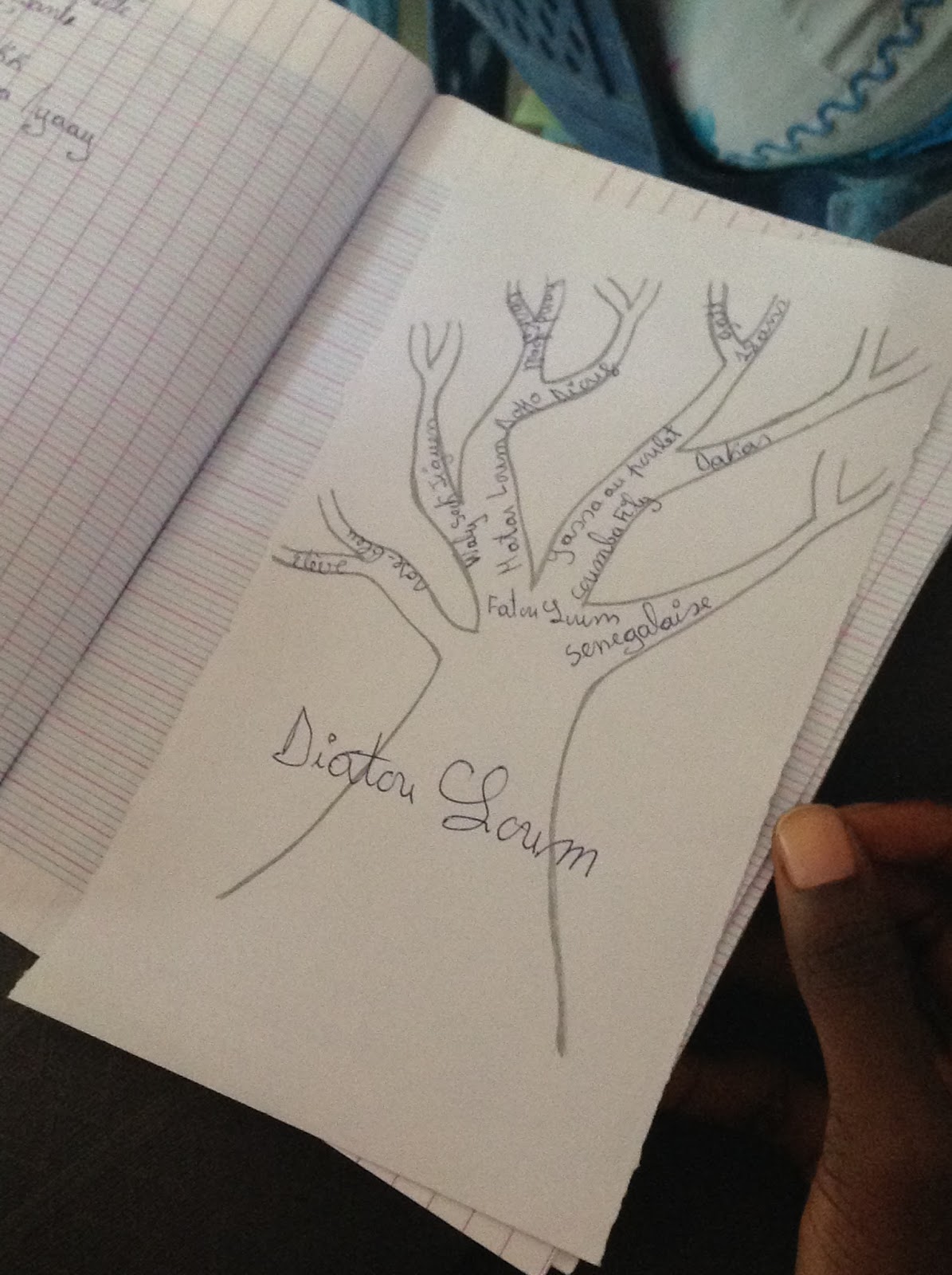
| After discussing what identity entails and 'knowing your self,' the girls made individual Baobab trees. Just like the strong, beautiful, unique Baobab trees that fill the landscape, each of the girls has her own important identity. In Diatou's example, she lists her age, nationality, family members, goals, music preferences, favorite dance move, etc. We then discussed how individual identities combine to create larger group identities. Like how the girls at the camp represented the strong, women of Senegal. On different colored papers the girls wrote "I am important," "I am a woman," "My goals" and drew the corresponding information underneath. We then created a 'Senegal identity quilt' by mixing up all the different papers and taping them on the classroom wall. Below one of the girls explains her "I am important" quilt piece. |
| On environment day, we discussed how humans interact the natural environment. When we first asked the students to explain their environment, they only listed buildings in the village. We slowly drew out all the parts of a natural habitat like trees, animals, water, ground water, etc. We then discussed how human interact with the environment through wells, farming, buildings, roads, etc. The girls drew the environments in their communities, notice how Fatou's drawing includes man-made structures including a water tower, wells, buildings, roads, and farms as well as the natural elements like rain, dirt, ground water, and animals. We ended the session by discussing how ecosystems can change and how we can respect the environment. |
| At the end of each session we had the students journal about what they had learned. By pausing to reflect on what we'd discussed, the students internalized the lessons and created mementos for them to look back on them. |
| On gender day, Peace Corp's Sidi Toure discussed domestic violence, the importance of education, and how this generation is part of a revolution for gender equality. "Two hands are used to put on a skirt, two hands are used to put on pants. They are equal." |
| We also led a debate about the role of women in Senegal. We asked questions like; \"Do you want the same life as your mother?", "Should your parents choose your husband, or should you?", "If you see forced early childhood marriage in your community should you go to the police and report it (since it's illegal), or should you respect the tradition?" For each question there were girls who believed in both sides and vigorous debate ensued. |
| Our goal for the debate was to encourage critical thinking, both in the moment and in the future. |
| On future/ goal setting day, we brought in the CED (community economic development) Peace Corps staff to discuss how income generation works and play the BEST game. The girls were split into teams, given businesses via a loan program and had to generate enough income to eventually pay the loan back. It was a great learning experience, the girls got very competitive, and they were able to articulate all the lessons from the game before staff did the debrief at the end. |
| The teams planning out their loan payment. |
AFTERNOON SESSIONS
| In the afternoons, we split the girls into rotations to do activities that corresponded with the day's theme. We did pre- and post- tests to see what information they retained from our morning sessions, art, social geography, skits, and various other sessions. On environment day, we made reusable bags from colorful Senegalese fabric. In the next year, Senegal will start charging for the use of the currently free ubiquitous, black, plastic bags. |
| In our social geography sessions we discussed how the day's theme is different around the world. Denise and I discussed the various challenges to eating nutritious meals including how the environment affects each country's ability to grow food, proximity to water (for fish and exports), national GDP, average family size, and (most importantly) choice. |
| On health day, the girls drew what they need to choose to make a nutritionally sound lunch. Most of them chose to draw a healthy version of the national dish "cheeb u jen" (fish and rice), laden with vegetables and a limited amount of oil and MSG. |
| A general first-aid session. |
| On future/ goal setting day, our CED volunteers talked to the girls about career planning. After listing three things they wanted to achieve in the next 10 years, the volunteers helped the girls think out the step-by-step process of achieving them. For example, if a girl wanted to start a family, become a doctor, and graduate from school, what order would those come in and what additional steps are needed to become a doctor? Extra schooling or training? What languages will you need to speak, etc. It was an excellent session as the girls started mapping out the steps to achieving their dreams. |
![]() |
SPORTS
| No matter the activity, the girls loved to play. Water balloons were a huge hit! (Especially when the girls started aiming at PC Volunteers!) |
| Most girls have never swam, so getting wet in the mangroves was one of the highlights of many of their experience. |
![]() |
| Our final sports activity was an enormous game of capture the flag with water balloons. Over forty participants, several hundred balloons, and almost a hectare of playing space equals a lot of fun. |
the PEOPLE involved
| Goofy PC volunteer camp counselors, who said we were fit to be in charge of all these kids. |
![]() |
| Behind the scenes prep and planning. |
| Some of us try to work hard, but those Peace Corps drivers just love to tease us. |
| A huge thanks to all those volunteers we worked to the point of exhaustion. |
| Sidi sharing a moment with our Senegalese camp counselors. |
GIRLS TALENT SHOW
![]() |
| The final night the girls put on their own talent show. They made their own skits, dances, and songs to surprise us PC Volunteers. This was a lengthy skit about how to address early marriage in your communities, including a respectful inclusion of community leaders and parents. Below, each of us PC Volunteers was imitated by one of the girls or Senegalese counselors. They were surprisingly astute, capturing our mannerisms, favorite word choices, and dance moves. Favorite props were glasses and the outfits we used at our dance night. |
![]() |
| The girls singing Celine Dion's "Mother and the Child." |
DANCING
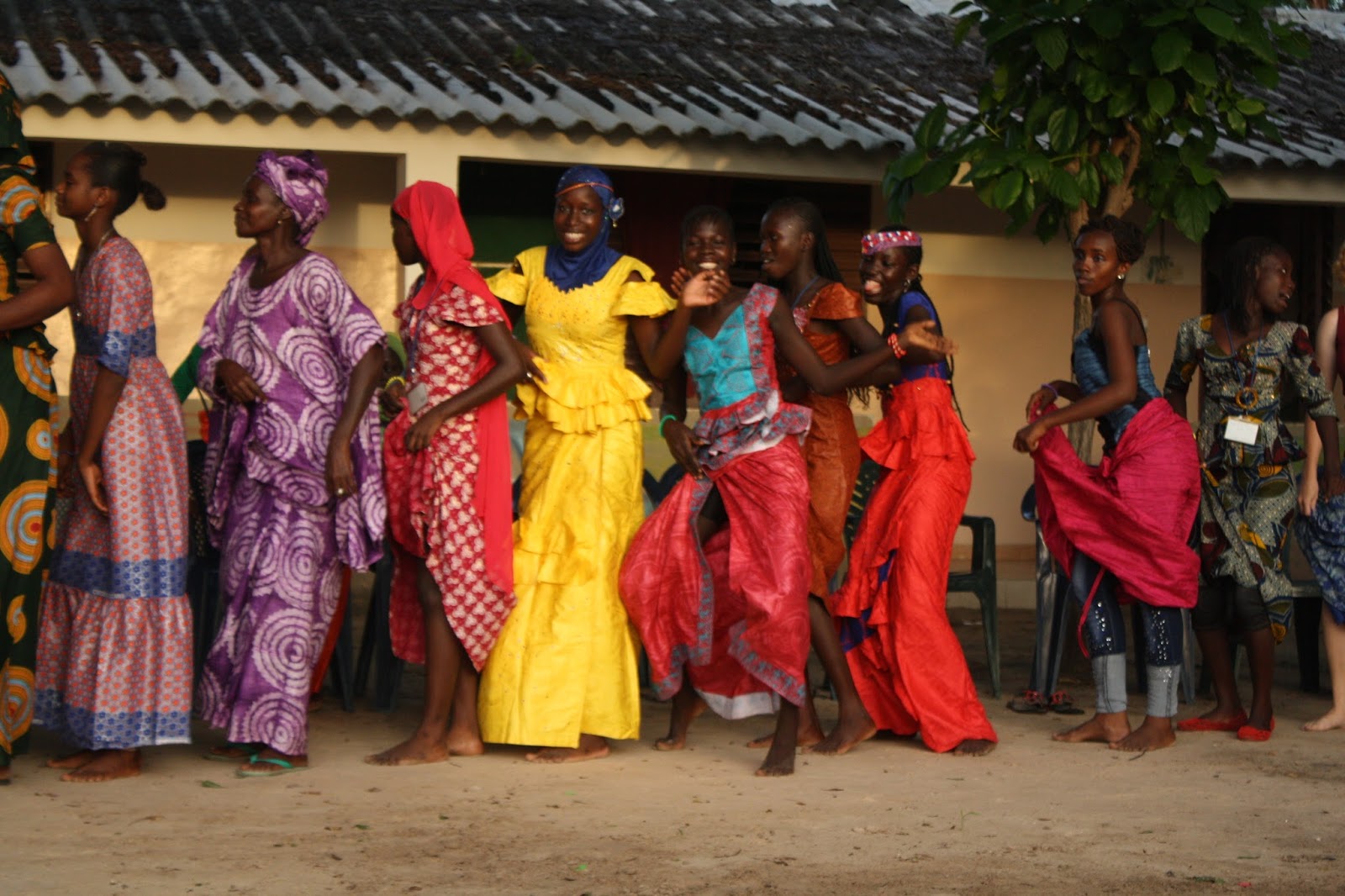
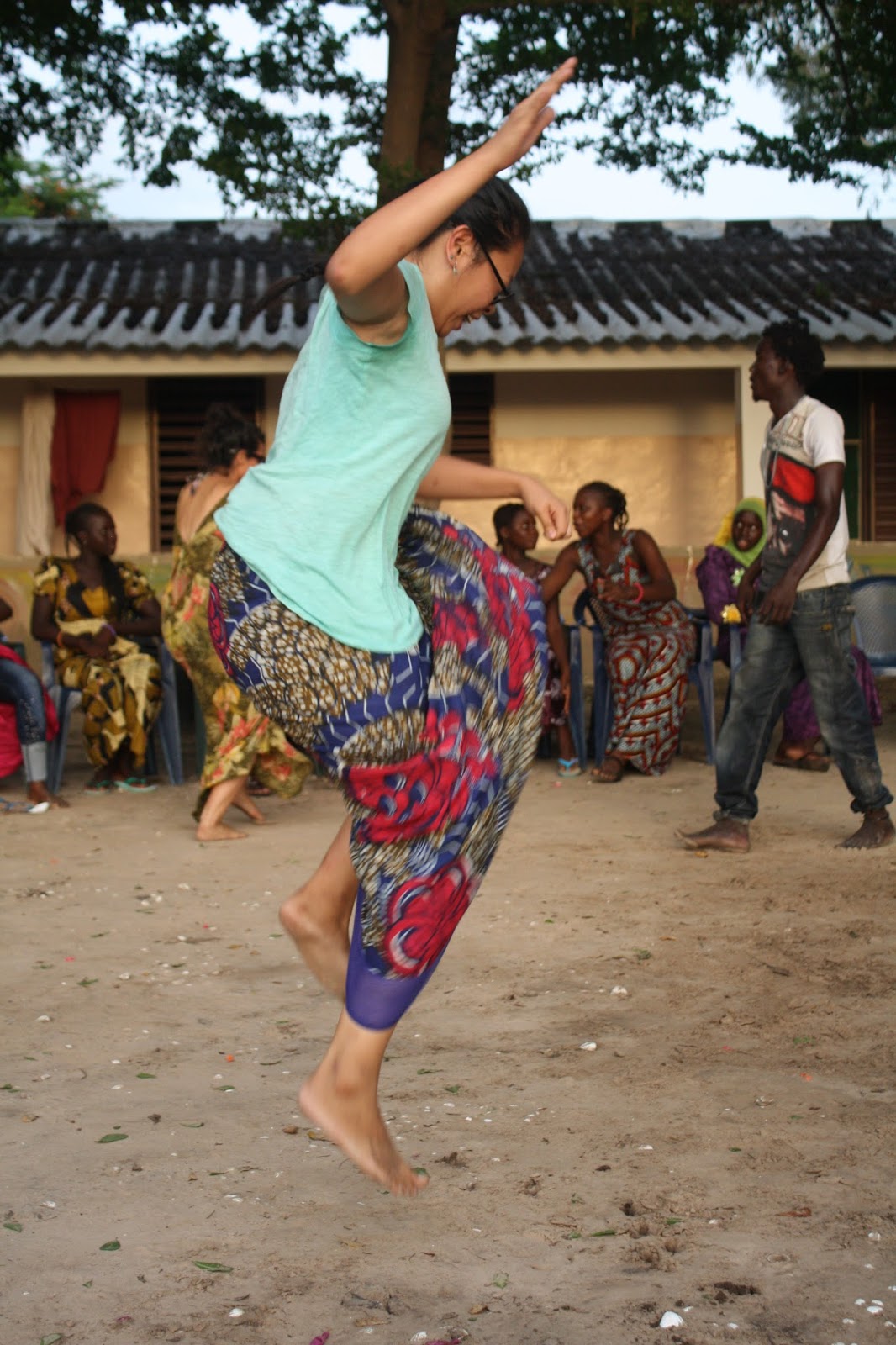
| The most successful event was our 'Sabaar' or night of Senegalese dancing. We brought in a local drumming troupe, sat the girls in an enormous circle, and danced until exhaustion. Above is one of our Senegalese counselors showing off her moves. |
| Some of the girls were more shy than others, so I would come and have them join me in the circle. |
| And she seemed to enjoy it! |
| Look at all those beautiful dance moves and dresses! |
| Us volunteers showing off our best moves. |
![]() |
| Thank you everybody for an excellent camp! What an excellent capstone to my service! |
Subscribe to:
Posts (Atom)